





Big Sampson brings big wind power numbers
ENGIE North America's recently completed 207 MW Big Sampson wind project is now adding to the big wind power numbers for Texas
By Paul MacDonald
Texas continues to be the leading state in wind power generation in the U.S., by a country mile.
The most recent numbers from the American Clean Power Association (ACP) show the Lone Star State with some 53,568 megawatts (MW) of wind power at the end of 2025, more than triple the #2 state, Oklahoma, with its 13,879 MW.
Wind power alone produces 21 percent of all electricity in the state, and Texas generates some 28 percent of the entire country's wind energy.
Total clean power investment in Texas to date is estimated at over $83.2 billion, and more than $297 million in state and local tax dollars are generated by these projects, and more than $301 million annually goes to Texas residents directly in the form of land lease payments.
Clean power, both wind and solar, brings Texans a host of economic benefits at the state and local level, boosting job creation and contributing immensely to the local tax base. These projects provide a secure, local source of energy, and importantly, save water, compared to other types of power generation.
ENGIE North America’s 270 MW Big Sampson Wind Project, which completed construction in late-2025, is now part of those big wind numbers for Texas.
The Big Sampson project is located in Crockett County (named after Davey Crockett, a famous American frontiersman who was a hero at the?Battle of the Alamo), in West Texas. Like many regions in Texas, jobs and local government funding have been dependent on oil and natural gas revenue, and its ups and downs. But wind power projects like Big Sampson—and there are a few wind projects in Crockett County—are helping to even out, and add to, local government budgets.
Filling out the local picture a bit, Ozona is the only town in the 2,800 square miles of Crockett County, and, with its 2,485 residents, it tags itself as “The Biggest Little Town in the World”. The county looks to be ideal for wind farms, being among the most rural counties in Texas, at one person per square mile.
Sitting on the Edwards Plateau in the county, the nearly half-a-billion-dollar Big Sampson Wind project is designed to generate 270 MW from its 60 4.5 MW Vestas turbines.
Camille Chardonnet, Senior Project Manager at ENGIE North America and the project manager for Big Sampson, noted that—as reflected by the other wind power projects in the county—that Big Sampson sits in an area with strong wind resources, and many local landowners have shown interest in hosting wind development.
“With the Big Sampson site, after earlier leases ended, a developer initiated new feasibility work, and ENGIE later advanced the project following its acquisition,” she explained. “Throughout the process, both landowners and the broader community have consistently expressed support for responsible wind energy development in the region.”
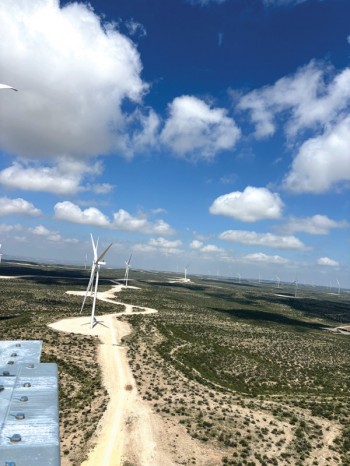 | |
This broader region in West Texas is widely recognized for its strong wind resources and expansive open landscapes, making it well-suited for wind energy development.
In general, ENGIE’s focus is on starting, and taking wind power projects though to completion and operation through its entire lifetime, although it does sometimes take on already-developed projects—as with Big
Sampson.
“Developing greenfield projects is our preferred approach, but our U.S. growth in recent years of 1 to 2 gigawatts annually means ENGIE also expands its portfolio through acquisitions at various stages of project maturity,” said Chardonnet. “I’d add that strong and early engagement with communities and other stakeholders is always part of our approach at ENGIE.”
There are further good reasons why Texas is a leader in U.S. wind power development and capacity, beyond its wind resources. Texas is widely regarded as one of the most streamlined states for renewable energy development due to its straightforward permitting environment, says Chardonnet.
Crockett County was familiar with the Big Sampson project and supportive of its development, noting that it placed minimal demand on local infrastructure. Only one lightly traveled county road was used, with most construction traffic routed along state highways. The county also benefits from the project through tax
revenues. “Again, consistent engagement with local communities is always part of our approach,” said
Chardonnet
She explained that the Big Sampson site is made up of mesas and naturally scattered vegetation across four landowners’ properties. Landowner involvement varied; some lived on their land and were in regular contact with ENGIE and the Engineering, Procurement and Construction (EPC) team, while others lived out of state and communicated through their ranch managers or legal representatives. “Maintaining consistent communication was essential to the project, ensuring that any decisions affecting the land were discussed and agreed upon collaboratively,” says Chardonnet
For Big Sampson, substantial civil work was necessary to prepare for turbine component delivery. This included grading and constructing access roads across the mesas to meet the slope and turning radius requirements needed to safely transport large turbine components. Because the project was located entirely on private land, no county level involvement was required for road construction or upgrades.
ENGIE works with a group of select EPCs on their wind projects—and these EPCs have to meet the company’s well-established guidelines, says Chardonnet.
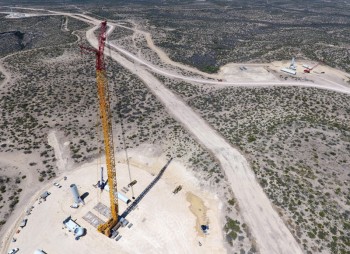 | |
ENGIE North America’s 270 MW Big Sampson Wind Project, which completed construction in late-2025, is now part of the big wind numbers for Texas. Recent numbers from the American Clean Power Association (ACP) show the Lone Star State with some 53,568 megawatts (MW) of wind power at the end of 2025. | |
“When we’re selecting an EPC partner for a wind project, ENGIE prioritizes experience and strong safety track record—especially in areas such as working at heights and managing cranes and suspended loads—along with a robust quality assurance program.
“Experience with the specific turbine supplier and model, as well as a proven track record in complex civil construction, are among the key considerations. Competitiveness is essential, and because ENGIE remains closely involved throughout construction, a collaborative, customer-focused mindset is equally
important.”
As a major developer and renewable energy producer—ENGIE North America has more than eleven gigawatts of renewable energy production in operation or under construction across the U.S. and Canada—the company brings a wealth of experience to the table. It knows what makes a successful wind project.
“Above all, placing safety at the forefront of every decision and activity is critical to ensuring a successful and responsible project outcome,” says Chardonnet.
“Beyond safety, several elements are key to delivering a successful wind project, in our experience.
“First, a strong benchmarking phase sets the foundation—this includes providing proper training, ensuring complete and timely transfer of documentation such as technical manuals, and aligning on a reference turbine for quality expectations.
“Second, close coordination and clear communication between the EPC and the turbine supplier is essential from early planning through construction. This includes aligning
schedules, ensuring adequate technical support and communication on site, and managing any issues, such as replacement of defective components, damage repair, in a timely manner.”
Close coordination is essential on a large wind project—a reminder that Big Sampson is 270 MW, with 60 turbines—particularly when turbine suppliers and EPC teams have had limited recent opportunities to work together or when a new turbine model is being introduced.
“For ENGIE, it was important to ensure clear communication channels among all parties, including timely exchange of documents and installation materials,” says Chardonnet. “This collaboration also helped us address technical questions and resolve any issues quickly during turbine installation and the mechanical completion process, supporting a smooth and efficient construction process.”
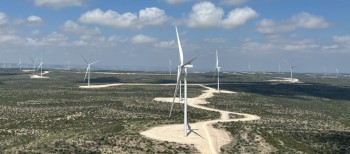 | |
Sitting on the Edwards Plateau in Crockett County (named after Davey Crockett, a hero at the?Battle of the Alamo), the nearly half-a-billion dollar Big Sampson Wind project is designed to generate 270 MW from its 60 4.5 MW Vestas turbines. | |
On a project of this scale, the construction sequence is driven primarily by crane usage, as crane mobilization represents one of the largest installation costs. Once access roads are ready, minimizing the distance cranes must travel becomes the key factor in determining the order of turbine installation. The overall size of the project and the targeted construction timeline also influence how many cranes are deployed, which then informs the most efficient sequence for building out the site.
Big Sampson Wind benefited from being located in an area where multiple wind farms were already under development. As a result, the utility point of interconnection for this project will ultimately be shared with nine other wind facilities, enabling efficient use of grid infrastructure.
ENGIE selects turbine models based on a combination of factors, including overall cost competitiveness, expected energy production for the project’s specific location, and the strength of the manufacturer’s quality program during production, explained Chardonnet.
While interconnection ultimately sets the maximum project size, the decision is made early in development and gives the team room to be ambitious. For Big Sampson, the final size was determined by two main factors: the availability of suitable turbine locations on the mesa terrain, and the need to balance project economics—matching the cost of the turbines with the energy output and expected revenue.
The site’s proximity to a Texas highway—only about three to four miles away— was a significant advantage for transporting components efficiently. Weather, however, did present challenges. High winds caused more than 40 days of delays during construction, and drought conditions at times created very dusty terrain. Despite these factors, the location offered strong logistical access overall, says Chardonnet.
The biggest challenge for the Big Sampson project, she says, was integrating a new wind turbine model that the selected EPC team was installing for the first time. Each new turbine generation increases in size, which adds complexity and additional safety and quality risk. This required a heightened focus on training, strong technical support during installation, and strict safety measures. Even the turbine supplier’s crews needed time to become fully familiar with the new model during commissioning, so close attention and quick issue resolution were essential to keeping the project on track, says Chardonnet.
The corporate community has been quick to tie in to the Sampson Wind project. In February, Sonoco Products Company, one of the largest global packaging companies, and ENGIE announced that delivery of the Virtual Power Purchase Agreement (VPPA) for production from Big Sampson has commenced.
Under the VPPA, Sonoco and ENGIE contracted an estimated 140 megawatts of electricity per year, representing approximately 83 percent of Sonoco’s U.S. electricity consumption in 2025 and approximately 52 percent of the expected output capacity of Big Sampson, for 15 years.
The Big Sampson wind project is now supporting Sonoco’s renewable energy ambitions and helping them meet over 83 percent of their purchased electricity needs in the U.S. and Canada through the VPPA.
“The commitment of customers like Sonoco and ENGIE’s track record of delivery are helping to accelerate the addition of new clean power to the U.S. grid to meet increasing demand and support economic growth,” said Chardonnet.
Q3 2026