




Trio of agrivoltaics projects powered by partnership
GreenSpark Solar and Encore Renewable Energy recently completed three agrivoltaics projects in New York and Vermont which are delivering locally generated solar power, while preserving agricultural land?"and expanding the companies� geographic
By Diane Mettler
There are still those who don’t put farming and solar together. Then they see sheep peacefully grazing beneath rows of solar panels—and suddenly the partnership makes perfect sense.
That’s exactly the vision behind a 13-megawatt (MW) portfolio of agrivoltaic community solar projects recently completed across New York and Vermont by Encore Renewable Energy and GreenSpark Solar. The partnership marked a milestone for both companies—Encore’s first completed solar projects in New York and GreenSpark Solar’s first completed community solar projects in Vermont.
Completed between late 2025 and early 2026, the portfolio included:
- Constable Solar (Constable, NY) – 3.8 MW DC
- Boardman Hill Solar (West Rutland, VT) – 2.9 MW DC
- Danyow Solar (Sheldon, VT) – 6.3 MW DC
The two companies, with complementary strengths and a shared sense of purpose, worked toward a common goal. Encore handled the projects up to construction, then GreenSpark took it from there. Listening to the teams from Encore and GreenSpark, you sense another great partnership. It’s hard to tell where one company ends and the other begins. They speak less like business partners and more like longtime colleagues who genuinely enjoy working together.
Encore’s ag projects start with the land and productivity. It pushes back on the idea of “solar on farmland”.
Encore’s Founder and President Chad Farrell noted, “It’s not really how we think about it. A lot of the land we work with isn’t in active agricultural production when we arrive. It may have been farmed at some point, but by the time we’re involved, it’s often sitting idle, or the economics of continuing to farm it have become too difficult.
“Solar development becomes an opportunity to bring that land back into productive agricultural use, whether through sheep grazing, pollinator habitat, or down the road, co-located crop production,” he added. “The solar project is what makes the economics work, but restoring and sustaining agricultural activity alongside it is very much part of what we’re trying to do.”
That said, having a project located on a farm doesn’t fundamentally change how Encore develops a solar project. “What we’ve learned is that some proactive thinking early on can set a project up for much better agricultural outcomes over its lifetime, and the more of these we do, the better we get at knowing where those early decisions actually matter,” added Farrell.
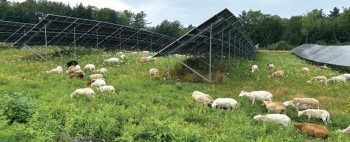 | |
At the Constable Solar project in northern New York, GreenSpark Solar and Encore Renewable Energy are working with the local Pierce Family Farm, whose flock now grazes the site, and Vermont’s Boardman Hill and Danyow Solar projects are both grazed by Lewis Fox at Agrivoltaic Solutions, who handles all of Encore’s Vermont and Maine grazing. | |
What are some of those early decisions? Fencing is one. Fencing is already required on every solar site, but in this case, it is determining what kind, like a mesh that sits flush to the ground to keep sheep in rather than just keeping people (and predators) out.
Access roads are another. Already required to build to accommodate emergency vehicles, with a farm, they may now need to handle a livestock trailer. Gate placement needs to be thoughtfully planned so that a grazer can move a flock around the site or across adjacent parcels. And when choosing seed mix, there are options like a forage mix that can be specified to work better for the animals.
“It’s much easier to work through optimization of the project for grazing at the design stage than to go back and retrofit the site following construction, though there is work being done in the industry on exactly that,” offered Farrell.
Each site had its own unique characteristics. Constable Solar in northern New York was a former hay field and flat. “We acquired it from Citrine Power rather than developing it ourselves, so we came into a design we hadn’t built from scratch,” said Farrell. “Adapting that to GreenSpark’s construction approach while setting the site up for grazing was a low-lift exercise, and we’re glad to be working with the local Pierce Family Farm, whose flock now grazes the site.”
Vermont’s Boardman Hill and Danyow Solar are both grazed by Lewis Fox at Agrivoltaic Solutions, who handles all of Encore’s Vermont and Maine grazing and has been a terrific partner in figuring out what each site needs.
Encore works closely with farmers by design. “The family who owns the Constable site are long-time stewards of that land, and that matters to us. Keeping their hay field in active agricultural use, rather than simply converting it to an industrial installation, was important to everyone involved,” said Farrell. “The plan for any given site is shaped by the specific conditions and the people connected to it, not pulled from a template. Lease agreements are written to keep future options open, because we’re thinking about these as long-term relationships.”
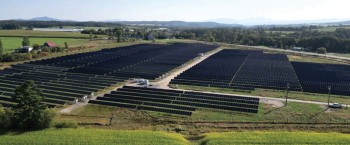 | |
A 13-megawatt portfolio of agrivoltaic community solar projects was recently completed across New York and Vermont by Encore Renewable Energy and GreenSpark Solar, and the two companies, with complementary strengths and a shared sense of purpose, worked toward a common goal. Encore handled the projects up to construction, then GreenSpark took it from there, building the projects | |
Working with farmers is one challenge, but working with regulatory agencies across two states was another set of challenges, noted Farrell.
“In New York, Constable Solar operates under the NY-Sun Initiative and the VDER program, the state’s Value of Distributed Energy Resources tariff, under which NYSEG compensates the project for electricity produced. Getting there meant navigating New York’s specific interconnection and community solar approval processes.
“Vermont works differently,” said Farrell. “Boardman Hill was awarded through the state’s Standard Offer Program, a competitive procurement process for renewable energy, and required a Certificate of Public Good from the Vermont Public Utility Commission. That CPG process involves community input, environmental review, and, ultimately, commission approval.
“The Danyow Road project supports Green Mountain Power’s customer driven clean energy program and went through the same Vermont permitting framework. Running two entirely separate regulatory pipelines at the same time, with different program structures, timelines, and requirements, is demanding work and exactly where our development experience made a difference.”
When all was in place and it was time to construct the projects, GreenSpark Solar stepped in. The two companies worked in parallel, keeping communications open as the projects took shape.
“In the case of this portfolio, our role was build only, but we have extensive experience in both development and the long-term operations and maintenance,” explained Kelsey Calaci, Marketing Manager, GreenSpark. “It was a great partnership because we were able to bring expertise and collaboration to elements throughout the planning process. Our project management team had nothing but great things to say about the collaboration between the two teams.”
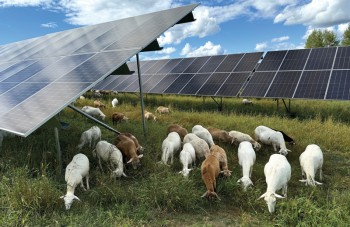 | |
Solar development can become an opportunity to bring land back into productive agricultural use, whether through sheep grazing, pollinator habitat, or down the road, co-located crop production. | |
For all three projects, bifacial solar panels were used, with fixed tilt racking on the New York project provided by Terrasmart and an OMCO high-level tracking system, used on the Vermont sites. As for inverters,
Encore’s design specified Chint Power Systems (CPS) for all three projects.
GreenSpark says understanding the unique design and engineering decisions going in is essential, because they affect much of the civil and finishing work. But otherwise, an agrivoltaic site really isn’t all that different than another site from a build perspective.
James Brown, a GreenSpark Site Superintendent, says that Constable and Boardman got underway simultaneously and had separate crews so that both sites could progress within a similar timeline—he added that they try to hire local subcontractors first. Brown noted that of the three sites, Boardman presented some terrain challenges. “It was a lot rockier terrain than the other two sites, which can often be the case when converting prior farmland. The rocky terrain is less desirable for farming, so converting it to an agrivoltaic site is a great way for landowners to repurpose it.”
Also, installation was completed in the colder months, which can present challenges.
Brown shared, “There are just certain challenges with being on a hillside in winter, such as drilling holes for the posts in frozen ground and storing equipment and materials as they come in.” And as for the cold, “it’s always safety first and the health and welfare of the people on site. We have heat for the cold loads. We have water and shade for the summer. That’s pretty standard. Got to take care of the people who are helping you out.”
One can sense the original “GreenSpark spirit” in its builds. The founders were college buddies who started working in the renewable energy field and decided they wanted to do it their way, and have been doing so since 2002.
As GreenSpark’s Kelsey Calaci shared, it instills a sense of family, collaboration, vision, and values, and continually reminds the company that the ‘planet is baking’. “And that’s why we’re here and do what we do. We’re going to keep doing it the way they want to, unapologetically, to help solve a global problem, while creating a damn cool place to work,” she said.
Calaci added, “It’s the collaborative spirit that is the unique part of the Encore/GreenSpark relationship. We are very different, but we’re very similar. We’re both very mission-focused and both part of the Amicus Solar Cooperative (a group of 90+ independently owned solar companies that share the same values across North America).
“These are things that our teams bonded over, and it showed up throughout the planning process in terms of being very collaborative, respectful, and proud of the work we’re doing together,” said Calaci.
Brown, who has done many projects in his nine-year career with GreenSpark added, “I loved working with Encore. They were just a fantastic company. They reminded me of a young GreenSpark team. There are a lot of similarities being a value-based company, just really good people.”
Bill Court, GreenSpark’s Manager of Site Superintendents, brought it home: “I think one of the things that really stood out to me about the partnership that GreenSpark and Encore created is that the teams both value putting people first, combatting climate change, and approaching challenges and overcoming them in a supportive way. That’s what really shined through.”
Q3 2026