





Installing solar power—with robots
Maximo, a solar robotics company incubated by the AES Corporation, has completed the successful installation of 100 megawatts of utility-scale solar capacity at the huge Bellefield project in California.
By Robin Brunet
The completion of a 100-megawatt utility-scale solar project is always a welcome addition to the growing clean energy inventory in the U.S. But in the case of AES Corporation’s Bellefield complex in Kern County, California, the 100 MW (part of a one-gigawatt array) is a landmark achievement for the solar energy industry, for a specific reason.
The Bellefield project represents one of the largest robotic solar deployments executed to date in the U.S.: four units developed and manufactured by Maximo, a solar robotics company incubated by AES, enabled work crews to nearly double the output of traditional installation methods in the region, while maintaining strict safety and quality standards.
Maximo’s success comes at a crucial time in the solar energy sector, when the demand for power overall is skyrocketing.
“Only so much can be done to accommodate accelerating schedules, not just with regard to hyper-scalers but also EPC companies,” says Maximo founder Deise Yumi Asami. “Solar panels are getting heavier, with work crews having to constantly move panels weighing 70 to 80 pounds throughout their shift. This severely compromises installation productivity, and the situation becomes critical if we consider that panels with hail protection each weigh several hundred pounds.”
The Maximo robots are also proving themselves at a time of concern about AI causing mass unemployment, but Asami rejects any notion that her company is a labor disruptor. “What we’re doing is no different than construction crews using cranes to lift materials that would otherwise be enormously difficult to handle,” she says.
Asami likens Maximo’s presence on solar builds to when robotics were first introduced to automobile manufacturing plants in the 1960s: the robots simply took over the intensely repetitive aspects of manufacturing, and staff were reassigned to other areas of production.
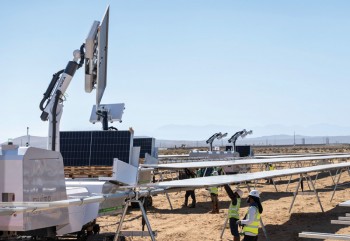 | |
On the Bellefield solar project in California, four Maximo units operated in parallel alongside skilled union technicians. In total, the project employed 1,000 union members at peak construction. | |
Of course, the technology Asami and her team has developed is a far cry from the robots that brought heightened efficiencies to the car-making industry several generations ago. Maximo combines a series of sensors, cameras, advanced computer vision, artificial intelligence and neural network algorithms to identify tracker structure, modules and other surroundings at solar construction projects, which serve as reference for the next module to be installed. AI gives these units a remarkable ability to understand what materials to pick, where to pick them from, and where to install them. Most crucially, they perform in a wide range of adverse weather conditions without slowing down or suffering a misstep.
Maximo’s origins date to eight years ago when Asami, who has an electrical engineering background, joined AES and was soon tasked with finding ways to improve the company’s financials on solar projects.
“We asked ourselves, ‘What value can we provide via automation?’ and that led to the exploration of a variety of concepts,” she says, adding that there was no precedent to draw from.
Publicly-traded AES’s considerable resources made such R&D possible: AES is the largest U.S.-based global power company and a leading investor, owner, and operator of power generation, utilities, and LNG infrastructure. Its portfolio includes solar, wind, hydro, natural gas, coal, and battery storage assets. Its many achievements include pioneering the model of an Independent Power Producer (in 1988); and being welcomed into the S&P 500 stock index (in 2000).
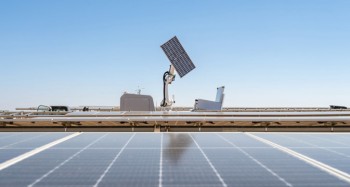 | |
The technical performance rate of the Maximos consistently surpassed one module per minute, and crews installed as many as 24 modules per shift hour per person, which is nearly double the output of traditional installation methods in the region. | |
The Maximo robot was developed to work within existing supply chains (to make it as versatile as possible), and Asami’s team worked with module and tracker OEMs to integrate the latest technology as it was released. In terms of appearance, Asami describes both the early prototype and later versions of Maximo as “about the size of a Ford F-250 and double the height,” running on a mobile microgrid and using lithium-ion iron phosphate batteries as a power source (AC/DC inverters and phase converters supply the three-phase electric power required to run the larger components of each unit).
AES also aided Maximo’s development in that Asami’s team could deploy the robot to different company solar project sites, to test and tweak installation capabilities and resiliency to adverse weather conditions.
“We deployed units in states such as New York, Ohio, and Virginia,” Asami says. “This gave us tremendous experience in terms of making sure the units were trained to operate without being affected by elements such as shadows caused by different angles of the sun.” Asami adds that maximum installation rates were achieved in snow, rain, and cold temperature conditions, and whether the terrain was sandy, muddy or bumpy.
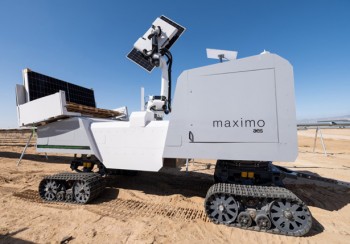 | |
Solar panels in the Maximos were replenished with skid steers or telehandlers, which easily loaded pallets of modules into the storage space through Maximo’s back panel. In total, the units installed 180,000 panels by the end of Phase Two of the Bellefield solar project earlier this year. | |
The Bellefield project on 7,500 acres of private land in California’s Kern County is the largest solar-plus-storage facility in the U.S., under contract with Amazon, and represents a significant step in accelerating the state’s commitment to achieving 100 percent carbon-free energy by 2045. In addition to powering homes and businesses, Bellefield’s solar array was intended to help strengthen the energy grid and ensure a sustainable, reliable energy supply during peak demand periods.
The project was designed to be constructed in two phases, each phase including 500 MW of solar plus 500 MW of four-hour duration battery energy storage. A 14-mile transmission line was designed to connect to the Southern California Edison (SCE) Windhub Substation, and AES owns and operates the completed facility, with $150 million in tax revenue expected to be generated over the lifetime of the project.
Leveraging the resources of NVIDIA Corporation (which develops graphics processing units, systems
on chips, and application programming interfaces for a variety of industries) the Maximo team tested and refined robotic capabilities through physics-based simulation and AI-driven modeling before deploying
to Kern County.
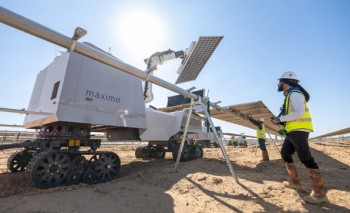 | |
This intense pre-planning enabled rapid expansion: the Bellefield project scaled from a single robot when work began in June 2023 to a coordinated fleet of four 3.0 version Maximo units operating in parallel alongside skilled union technicians (in total, the project employed 1,000 union members at peak construction).
“Construction safety was our highest priority, and every aspect of the construction phases was considered from this perspective,” Asami says. “For example, the height of the torque tubes connecting the rows of solar panels and supporting the structural load were up to eight feet high at some parts of the site, so we adapted our units to make sure they could reach those heights and that our people would stay on the ground instead of being perched on ladders.”
On site safety was augmented by regular briefings and specific operational zonings.
Staging and site preparation work at Bellefield was nearly identical to site prep and staging for a traditional installation. The Maximo units were each assisted by a human operator to move between rows and towed by a skid steer driver. The units’ AI-enabled computer vision system detected any inconsistencies in the installation process and self-corrected to minimize interruptions; a user interface enabled the operator to monitor the status of the unit, including the vision system and battery charge state.
Asami notes that although temperatures in the Mojave dropped dramatically at night and high winds were fairly common, work didn’t have to be paused. “The Maximo units kept going, thanks not only to the robust design of the units but also because we included factors such as warm-up times into our standard operating procedures, to ensure that we were able to meet our targets.” Solar panels in the Maximos were replenished with skid steers or telehandlers, which easily loaded pallets of modules into the storage space through Maximo’s back panel.
The technical performance rate of the 3.0 version Maximos consistently surpassed one module per minute, and crews installed as many as 24 modules per shift hour per person, which is nearly double the output of traditional installation methods in the region. “In total, the units installed 180,000 panels by the end of Phase Two earlier this year,” Asami says.
The Maximo team is currently developing the 4.0 version of robots, with the aim of providing services to EPCs who answer to project owners and need guarantees of a certain number of modules installed per day. “We see a huge opportunity to expand into other verticals,” Asami says. “However, we’re not aiming to expand in terms of number of units, per se; rather, the better we can get our robots to perform, the less robots we need to build.
“We estimate that 20 robots at today’s performance could deliver 1 gigawatt per year, which is substantial. And that’s only the beginning.”
Today, the U.S. solar industry installs about 15,000 modules per hour, weighing one million pounds. Looking ahead, this installation rate is projected to reach 50,000 modules per hour by 2035. Maximo’s ongoing evolution means more projects will come online faster—and ultimately increase the speed of energy transition to renewables.
Q3 2026