




Opening new solar power frontiers
A new tracker twin system installed on a New York solar power project opens new development frontiers?"and could breathe life back into shelved projects.
By Tony Kryzanowski
There’s no escaping the fact that when it comes to calculating the profitability of solar power projects, it all comes down to the math.
Today, the upfront costs are well known, with viability and profitability often dictated by topography, the solar power generating potential from each site and available technology options to develop the site.
Charlotte, North Carolina-based DCE Solar is shaking up the technology part of this calculation for American developers with the introduction to the U.S. of new racking technology called the Tracker Twin system.
DCE Solar is the American distributor and installer of this system developed by Valencia, Spain-based solar hardware provider, Axial Structural Solutions. They’ve been in business for nearly two decades, have installed in excess of 16 gigawatts of renewable power capacity throughout the world, and are considered one of the top three racking system providers working in the European market.
What’s noteworthy about the Axial Tracker Twin system is that it typically requires half as many drives and significantly fewer piles compared to other domestic tracker systems. While new to the U.S., this unique racking technology has been deployed globally by Axial Structure Systems for many years.
The first deployment of the Tracker Twin racking system in the U.S. was recently completed on a solar farm near the town of Cuba, in the southwestern part of
Allegany County in New York State, near the Pennsylvania border.
It is a 6.8 megawatt (MW) project on about four hectares, noted for its challenging topography, heavy annual snow loads and cold environment.
“We hit every kind of situation (on the Cuba site) to prove that this technology is the right technology—we’re trying to show our customers the extremes,” says DCE
Solar founder, CEO and owner, Bill Taylor.
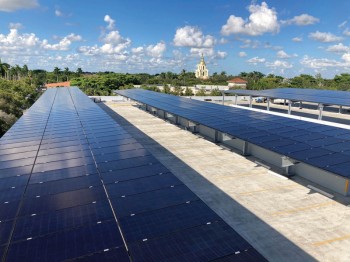 | |
The Tracker Twin system offers developers the opportunity to explore entirely new frontiers for solar deployment because of the system’s flexibility and durability, while at the same time potentially helping them avoid or minimize expensive civil costs in advance of development. | |
He emphasizes that it is not only the availability of the system that will benefit American developers, but also the reputation that DCE Solar has built over nearly two decades to supply and install high quality finished products.
Taylor describes the difference between a conventional single axis tracking system and the Tracker Twin system this way.
“A conventional single axis tracker typically features one torque tube to one row of modules, one drive per row and is supported by piles along the centre axis,” says Taylor. “The Tracker Twin actually links two rows (with a red homokinetic arm) so that they are a paired system, which reduces the number of motors.”
There is also greater structural integrity with a square and thicker torque tube versus a typical octagonal torque tube.
He adds that by using the Tracker Twin system, there is the potential for developers to achieve more power production within the fences of the solar farm.
“That’s because of the drive system,” Taylor says. “It has a lot of flexibility in its north-south orientation so that you can fit more megawatts on that square acreage. We are able to go 15 percent (offset) north-south and east-west as far as being able to manage the topography, so that is significant.
“And then row to row north-south, we have 30 percent (offset) tolerance, which is significant from the drive shaft itself. So that gives a lot of flexibility and that’s why you can get more megawatts on maybe a not-so-square plot of land.”
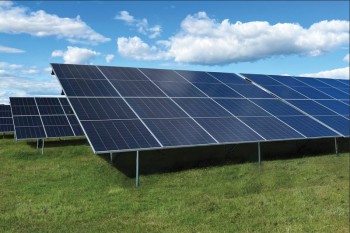 | |
What’s noteworthy about the Axial Tracker Twin system is that it typically requires half as many drives and significantly fewer piles compared to other domestic tracker systems. While new to the U.S., this unique racking technology has been deployed globally by Axial Structure Systems for many years. | |
So, in summary, because of the system’s flexibility on undulating land, the Tracker Twin drive system can be operated even when offset to this degree. That is what makes more megawatt delivery possible. And with this offset capability, the racking system can be oriented where radiation is the most intense to maximize power production.
However, the potential megawatt uptick is site specific and Taylor says that the best time to analyze the value-added that the system can offer is during the design phase, before the project is so far advanced that developers can’t realize the full potential of what the Tracker Twin system could offer.
Regarding the Cuba project, he adds that it was helpful that DCE Solar, as the racking supplier, was involved very early on in the design stage and worked closely with the owner to bring the flexibility and tolerances available from the Axial Tracker Twin system to its full potential. Their installation arm, DCE Services, operated as the general contractor on the project.
The technology is still competitive with other racking system providers when used on flatter ground and it still offers the advantage of needing half as many drives. Where it really shines, though, is with deployment on sites with more challenging terrain where developers have few if any racking system options to build a project or want to maximize the use of a site that may feature both flat and undulating terrain. It also has the potential to resurrect projects shelved because of past technical challenges related to deployment of a racking system.
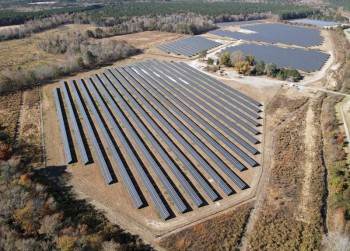 | |
With the New York solar project, it was helpful that DCE Solar, as the racking supplier, was involved very early on in the design stage and worked closely with the owner to bring the flexibility and tolerances available from the Axial Tracker Twin system to its full potential. | |
Deploying the Tracker Twin system can also significantly reduce upfront civil costs. There is a ‘SlopeSync’ option available for sites featuring more intense terrains and where there is a need for additional slope tolerance.
In addition to introducing this globally-unique racking system to the U.S., DCE Solar also intends to enter the utility scale development space with it, marking a notable milestone for the 17-year-old racking system provider and installer which up till now has worked in the commercial and industrial space exclusively with fixed tilt ground mounted racking systems, rooftop and carport systems, and now with a single axis tracker system. They’ve supplied and built projects throughout the U.S. Their partner, Axial Structural Solutions, has considerable experience working within the utility-scale space.
“This technology is being used on many, many large utility projects and is operating very well, and now we have the ability to benefit from this technology,” says Taylor.
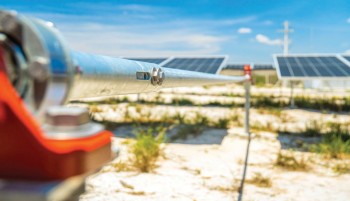 | |
Where the Tracker Twin system is said to really shine is with deployment on sites with more challenging terrain where developers have few if any racking system options to build a project or want to maximize the use of a site that may feature both flat and undulating terrain. | |
What’s also notable about the company’s partnership with Axial is that production of the components of the Tracker Twin system can be manufactured in the U.S. to address project domestic content requirements so developers can maximize federal and state construction and production credits.
Project manager Lisa Anderson describes the Cuba site as a project that climbs a mountainside with several hectares of flatter ground at the top.
“Actually, on this site, we were supposed to experience 30 percent refusals from rocks, stump roots, and features like that,” she says. “We managed to minimize that down to .01 percent and got through the worst of the site.”
She adds that part of the reason for this accomplishment is possibly because the site had been farmed previously.
Construction began in February and the racking and foundations were in place by April, with DCE crews working in extreme weather conditions featuring snow, rain and mud and with the need to deliver components using transport trucks up a mountainside in these conditions.
Electrification occurred on June 15 and features 5089 First Solar modules and HEMK inverters supplied by Power Electronics.
Taylor says that the Axial Tracker Twin system worked well on the Cuba site because it is a lot more forgiving with fewer piles because of the structural integrity of the torque tubes.
“You can build it faster because it gives you the tolerances,” he says. “So, in other words, if there is a pile that’s not ideally placed, you can adjust it out with the tolerances that are designed into the system.”
Another feature of the Tracker Twin system that DCE Solar discusses with developers during the design phase is the potential for installing a self-powering system for the drives rather than connecting the array to an external power source. This is where a dedicated solar module or string power drawn from the array is used to charge batteries that provide the drive motor power.
With this system, Taylor says that it is important to select the appropriate battery depending on how cold that environment can get. The self-powering system can be designed to operate to as low as -30°C.
By installing the self-powered system, Taylor says that developers can save additional costs in trenching and wiring typically required for external power.
In terms of the future potential for the Tracker Twin system, DCE Solar has already booked a number of projects that will feature this technology. Taylor says that there is still plenty of flatter terrain in the U.S. where current racking technology installed by quality suppliers and installers will remain competitive.
However, the Tracker Twin system offers developers the opportunity to explore entirely new frontiers for solar deployment because of the system’s flexibility and durability while at the same time potentially helping them avoid or minimize expensive civil costs in advance of development.
As mentioned earlier: it all comes down to the math. The bottom line is that the features of the DCE Axial Tracker Twin system in many instances can deliver a noticeable bump in project balance sheets for many American solar power project developers and owners.
Q3 2026